Nain Trading

How can we help you?

search
General Information regarding the carpets
General Information about Nain Trading
Questions regarding your order and payment:
Shipment, delivery and returns
Security and the protection of privacy

General Information regarding the carpets

  • What are the components of an oriental rug?

    An oriental rug is basically made up of warp, weft and pile. The warp and weft form the supporting fabric, while the pile creates the rug’s pattern. Depending on the type and origin of the rug, these basic materials are made from different fibres. The foundation, meaning the warp and weft, is often made of cotton, while the pile is crafted from high-quality sheep’s wool or silk. In pure silk rugs, however, all components are made from silk fibres. The warp threads run lengthways through the rug and usually end as fringes at the edge of the rug. The weft threads run across them. At the points where they intersect, the pile is created by tied knots, which then form the visible surface of the rug.

  • To what extent are the details and images of the rugs true to life?

    All information about our rugs in the online shop has been prepared to the best of our knowledge and to the highest technical standard. All dimensions have been carefully measured by us and should only have minor deviations at most. The weight is also determined again using a special hanging scale. The information on knot density consists of approximate estimated values. The images are taken by us on site with an excellent DSLR camera and reflect the colours and details of the rugs very accurately. Depending on the direction of the pile, the colours may appear lighter or darker, just as they do in real life. Naturally, the colours may differ from reality depending on your screen settings for brightness and contrast.

  • What are the most important criteria for a rug’s value?

    Normally, the difference in value between two similar rugs is determined by their different knot densities. Knot density is measured by the number of knots per m². However, in oriental rugs, knot density is not the only factor that determines their value. It is also important which materials have been used and, for example, how good the quality of the wool is. In silk rugs, the actual silk content is also significant for the value of the rug. Likewise, the workmanship and the beauty of the patterns produced also play a part. There are therefore many different factors that should be taken into account when assessing the value of a rug.

  • How do I estimate the approximate knot count per m² of my rug?

    If you want to calculate the knot count of an oriental rug per m², the best way is to choose a spot on the back of the rug and count the number of knots along a 1 cm horizontal line and a 1 cm vertical line. You then multiply these two figures together to get the approximate number of knots per 1 cm². To work out the number of knots per 1 m², you then need to multiply this result by 10,000. If you want a more accurate result, you can of course count the knots over a distance of, for example, 10 cm. In this case, you then only need to multiply by 100 at the end. It should also be noted that the knot density in the centre of the rug is often slightly higher than at the edge of the rug.

  • What do the terms 35, 50, 60 or 70 Raj mean for a Tabriz?

    For a Tabriz, the fineness of the rug is measured in rows, also known as Raj. This refers to the number of knot rows counted over a length of 7 cm. A Tabriz of quality 35 has an approximate knot density of 300,000 knots per m². 50 Raj corresponds to around 500,000 to 600,000 knots per m². In the 60 Raj Tabriz category, the rugs have 55 to 65 knot rows, which equals a knot density of approximately 650,000 to 900,000 knots per m². The highest quality from 70 Raj upwards is very rare and means a knot density of 1 million knots per m² or more.

  • What do the terms 12, 9, 6 or 4 La mean for a Nain rug?

    For a Nain rug, fineness is described by the number of thread layers per warp thread. The lower the number, the finer the knotting quality of the Nain rug. "La" means "layer" in Persian. The La of a Nain can be checked very easily by counting the threads in a rug fringe. A Nain with 9 La, for example, has 9 pairs of threads per fringe and therefore a medium knot density of approx. 400,000 to 600,000 knots per m². A Nain with 6 La has only 3 pairs and therefore a finer weave with a knot density of 850,000 to 1 million knots per m². The most exclusive Nain rugs have only 2 pairs of threads and therefore an exceptional fineness with a knot density of over 1 million knots per m².

  • What should I bear in mind about my new rug after delivery?

    Our rugs are shipped rolled or folded and can be used straight away once they arrive. Any creases in the rugs will settle over time. During the initial period of use, the rugs may shed a little more fluff in places. This is due to excess wool working loose through use and is completely normal and nothing to worry about. In most cases, this stops after vacuuming several times. If you have purchased a thinner rug, we recommend using a non-slip underlay so that it does not move out of place.

  • My rug has slight irregularities – should I be concerned about the quality now?

    You do not need to worry about the quality of your rug. Minor irregularities are perfectly normal in genuine handmade rugs. Most of our rugs are NOT machine-made and may therefore show slight variations. Fringes of different lengths, a slightly uneven shape or variations in colour are not uncommon in handmade rugs. These small "imperfections" do not reduce the value of your rug in any way; they simply show once again that you have purchased a genuine one-off piece.

  • Are the fringes included in the rug’s dimensions?

    No. The stated dimensions do not include the fringes. The length refers solely to the rug itself.

  • Can the rug be used with underfloor heating?

    Yes. All rugs offered by us are suitable for floors with underfloor heating. Naturally, the heating should be operated within normal temperature ranges.

  • How is the age of rugs defined?

    Our newly produced rugs are classified as new. If a rug is not newly produced, there is a good chance that it has had a previous owner. However, all rugs are cleaned and inspected for defects before we list them on the website.
    50–100 years and older If a rug is marked as being between 50 and 100 years old, this means it is an antique rug. These are considered very valuable, as they are very rare rugs.

  • My rug is shedding, what should I do?

    It is perfectly normal for a new rug to shed fluff, and this will always occur to some extent. This is excess material trapped in the rug after trimming, which is gradually released over time. This should stop after a few months with normal use and vacuuming.

  • How do I clean my rug?

    The care instructions for the rug vary depending on the material. We always recommend that you contact a professional rug cleaner rather than trying to wash the rug yourself. We also clean rugs and will be happy to give you personal advice on cleaning if you have any questions.

  • Is this size / colour in stock?

    We have unique rugs, each one is one of a kind. Try our search filter to find suitable alternatives. Our customer service team will also be happy to help you find a rug that meets your requirements.

  • How do I remove creases or fold marks from my rug?

    To ensure your rug arrives safely and takes up as little space as possible, it will be rolled or folded for shipping depending on its size. As a result, slight creases, waves or fold marks may be visible temporarily after unpacking. This is completely normal and not a quality defect.

    In most cases, these marks disappear on their own once the rug has been lying flat on the floor for a few days or weeks. Hand-knotted rugs are made from natural materials such as pure new wool or silk, which return to their original shape after a short time.

    If you would like to speed up the process, the following measures can help:

    • Unroll the rug and leave it flat: Often, it is enough to simply give the rug a little time. The fibres will relax naturally with use.
    • Weigh it down: Place heavy objects such as books or boxes on the affected areas to smooth out creases more quickly.
    • Roll it in the opposite direction: Carefully roll the rug in the opposite direction for a few hours or days. This is particularly helpful for more pronounced waves along the edges.
    • Use gentle warmth: For stubborn fold marks, a slightly damp cloth and gentle warmth can help. However, avoid direct heat on delicate materials such as silk or viscose.

    If noticeable distortions remain after several weeks, please feel free to contact our customer service team. We will be happy to help.

  • Where can I find inspiration, interior design ideas and care tips for rugs?

    On our inspiration page, you will find plenty of inspiration, home décor ideas and practical guides on rugs and stylish interior design. Discover the latest home trends, helpful tips on choosing the right rug size and colour, care advice, as well as interesting information about materials, origins and craftsmanship.

    Whether for the living room, dining room, bedroom or hallway – our experts show you how the right rug can create a harmonious living atmosphere and highlight your personal interior style.

    You will also find fascinating background articles on hand-knotted oriental rugs, current rug trends and plenty of ideas for different interior styles – from modern and Scandinavian to classic and oriental.

    Visit our inspiration section and get inspired: Explore our home ideas, guides and inspiration.

  • How do I care for my rug properly?

    With the right care, a high-quality rug can bring pleasure for many decades. Hand-knotted rugs in particular are known for their durability and often become even more beautiful with regular care, as they develop a natural patina over time.

    For routine cleaning, it is usually enough to vacuum the rug regularly. Use a carpet nozzle without rotating brushes and a moderate suction setting to protect the fibres. Vacuum in the direction of the pile wherever possible and pay particular attention to areas with heavier wear.

    To encourage even wear, it is advisable to rotate the rug from time to time. This helps to distribute foot traffic and sunlight more evenly, so that individual areas do not wear out more than others.

    Stains should be treated as quickly as possible. Carefully remove liquids with a clean, absorbent cloth and blot the affected area. Rubbing should be avoided, as this can damage the fibres or work the stain deeper into the rug.

    Hand-knotted rugs are made for everyday use and can be used without any problem in living rooms, dining rooms or bedrooms. Despite their high-quality craftsmanship, they are hard-wearing and designed to withstand many years of intensive use.

    For particularly thorough cleaning, we recommend professional rug washing when needed. This helps to preserve the colours, structure and material over the long term.

    You can find more helpful tips on rug care, stain removal and cleaning on our inspiration page: Read our care and advice articles.

  • What should I consider when choosing a rug colour?

    The colour of a rug has a major influence on the feel of a room. It can create a calm and harmonious atmosphere or add deliberate accents. That is why it is worth choosing the rug colour not only according to personal taste, but also based on the size of the room, the furnishings and how the space is used.

    Light colours such as beige, cream or light grey often make rooms appear larger and more open. Darker shades such as anthracite, dark blue or brown, on the other hand, give a room more depth, cosiness and elegance.

    If the rug is meant to be a focal point, bold colours or high-contrast patterns can be a good choice. If it is intended to blend discreetly into the interior scheme, we recommend colours that are already reflected in the furniture, curtains or decorative elements.

    The way the room is used also plays a part. In high-traffic areas such as the living room, dining room or hallway, patterned rugs and medium to darker shades are often easier to maintain, as they make smaller marks and dirt less visible.

    With hand-knotted oriental rugs, it is also worth paying attention to how the colours appear under different lighting conditions. Depending on the daylight and viewing angle, colours may look lighter, darker or more vibrant.

    Ultimately, the rug colour should reflect your personal style and fit harmoniously into your home. If you are unsure, you will find plenty of examples, interior ideas and tips in our magazine to help you choose the right rug colour: See our interior ideas and furnishing guides.

  • What should I consider when choosing a rug for my living room?

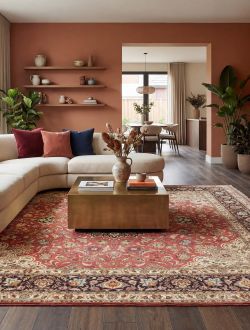
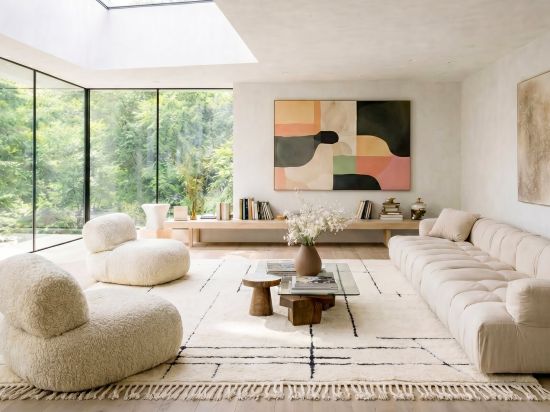
    The living room is often the heart of the home. A rug not only adds extra comfort here, but also brings furniture and living areas together into a harmonious overall look. That is why size, colour, material and design all play an important role when choosing one.

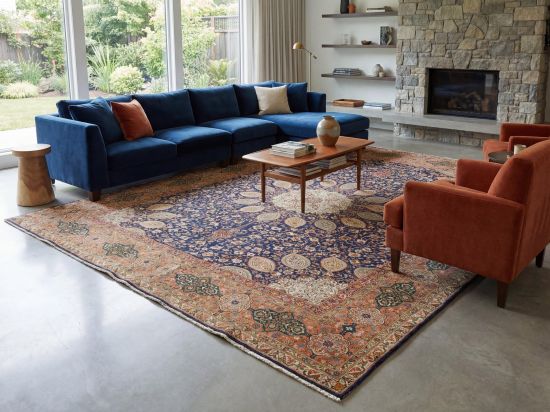
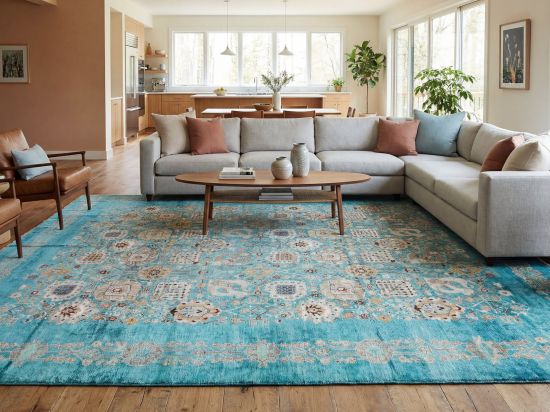
    The right rug size is particularly important. In many living spaces, it looks best when at least the front legs of the sofa and armchairs are placed on the rug. This creates a visual unity and makes the room feel more spacious and structured. A rug that is too small, on the other hand, can quickly look lost and disrupt the overall appearance.

    The choice of colour should also be matched to your existing interior. Light-coloured rugs often make rooms appear larger, while darker shades create more warmth and cosiness. Patterned rugs can add interesting accents and make minor signs of everyday wear less noticeable.

    When choosing the material, it mainly comes down to your needs. Hand-knotted wool rugs are particularly durable, easy to care for and pleasantly soft. Silk or viscose rugs impress with their elegant sheen and are especially suitable for more formal living areas.

    Another important point is how the room is used. In heavily used living rooms, we recommend robust materials and hard-wearing rugs that retain their beauty even after many years.

    Our tip: it is better to choose a rug that is slightly too large than too small. A generously sized rug usually makes the room feel more refined, calmer and more inviting.

    You can find more tips on choosing the right rug size, colour and suitable interior style in our magazine: Explore our home inspiration and rug guides.

  • What should I consider when choosing the rug size?

    The right rug size has a big impact on how a room feels. A rug should not only look attractive, but also connect the furniture and clearly define the living area. In fact, a rug that is too small is one of the most common interior design mistakes.

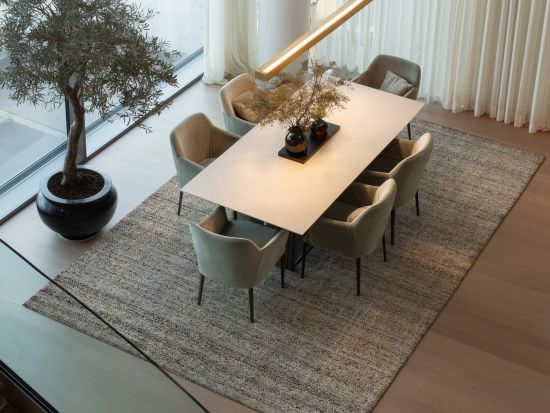
    In the living room, a rug usually looks most harmonious when at least the front legs of the sofa and armchairs are placed on it. This creates a cohesive look and makes the room feel larger and more refined. In the dining room, the rug should offer enough space so that chairs remain fully on the rug even when pulled out.

    As a general rule: it is better to choose a rug that is slightly too large than too small. A generously sized rug brings calm to a room, while a rug that is too small often looks lost and can disrupt the proportions of the space.

    Alongside size, shape also plays an important role. Rectangular rugs are particularly well suited to most living and dining areas, while round rugs can create interesting accents and soften smaller seating arrangements.

    The shape of the room should also be taken into account. In narrow rooms, the orientation of the rug can influence the overall effect of the space. A well-placed rug can help the room appear more balanced and harmonious.

    Our tip: before buying, mark out the desired rug size on the floor using newspaper or masking tape. This will give you a realistic impression of how the rug will look in the room later on.

    You can find detailed information and practical examples on choosing the right rug size in our magazine: See our guides and home inspiration.

  • Can the same rug be sold more than once?

    In most cases, no. A large part of our range consists of hand-knotted one-off pieces, each of which is available only once. If such a rug is sold, that exact individual piece is no longer available.

    As hand-knotted rugs are made using traditional craftsmanship, no two rugs are ever completely identical. Even if similar designs or patterns are knotted again, they often differ in size, colour shades, material, knot density or other handcrafted details.

    The availability of our rugs is updated continuously. As soon as a rug is sold, it is usually removed from the range to prevent duplicate sales.

    In addition to one-off pieces, we also occasionally stock rug collections in which several examples of one design may be available. The relevant availability is shown on the respective product page.

    If you particularly like a rug, we therefore recommend not waiting too long before making your purchase decision. Many of our most popular rugs are one-off pieces and are not available again once sold.

Didn't find the right answer?