Black Weeks – Exclusive 20% off all rugs
Discover distinctive rugs for a home with character. Enjoy 20% off our entire rug collection during Black Weeks.
Discount code: BLACK20
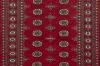
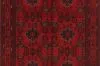
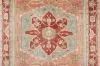
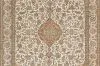
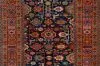
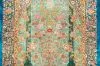
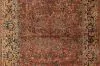
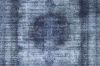
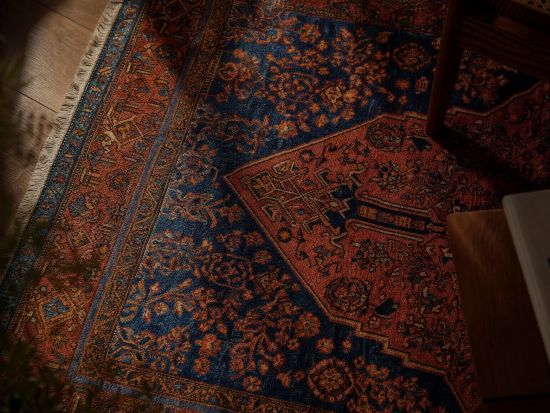
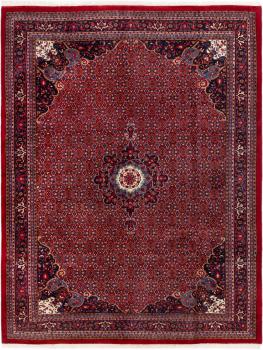
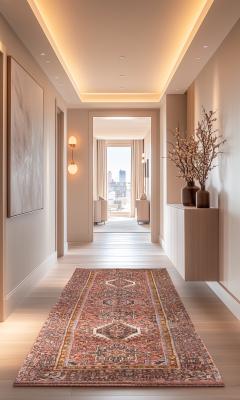
This Persian carpet has been crafted in a small Kurdish town in Western Persia. Bidjar carpets stand for high quality and contemporary design. With geometric patterns and ornaments it is highly popular even for modern interior concepts. Additionally, its compact pile is popular due to its resilience and robustness. This Persian rug made by a Kurdish minority is a great and long-lasting choice you wouldn't want to miss anymore.
Dense, heavy and exceptionally durable
This Bidjar belongs to a type of rug known for its exceptional strength. During knotting, the weft threads are dampened and beaten down firmly, row by row, with a heavy comb. This creates a very dense wool pile that feels firm and gives the rug its substantial weight. Dirt barely penetrates the pile, and a Bidjar retains its shape for a long time, even in busy rooms such as living rooms, dining rooms and hallways. Typical designs include the intricate Herati pattern, also known as Mahi, and clearly defined medallions. Due to its firm structure, a Bidjar should be rolled rather than folded.
Kurdish rug-weaving from Bijar
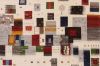
Bidjar is a small town in the province of Kurdistan in western Iran. Its rugs combine the bold character of Kurdish village rugs with the patterns of Persian city rugs. Rug weaving for trade in the area is documented from the 19th century onwards. In the rug trade, the town is also known by its historical name, Garrus, which gives its name to a celebrated arabesque pattern. A distinctive feature is the Wagireh: small pattern samples that served as guides for women weavers and are now collected in their own right. Antique Bidjar rugs from the 19th century are sought-after collectors’ pieces, partly because their construction makes them particularly durable.
Pile: Hand-spun wool
This rug is made from hand-spun sheep’s wool of the highest quality. Wool is still spun by hand, especially in Iran (formerly Persia), Afghanistan and Pakistan, before the actual knotting of the rug begins. Over the centuries, wool has proven itself to be a natural and extremely hard-wearing material. Among other things, it has dirt-repellent and heat-insulating properties. At the same time, wool is incomparably soft and has a natural sheen.Warp: Natural Cotton
As a natural textile fibre obtained from plants, cotton is durable and is often used in rugs. As with clothing, cotton is characterised by a soft feel while also having a strong structure. In hand-knotted rugs, cotton is often used for the warp on the back, or rather for the rug’s foundation.
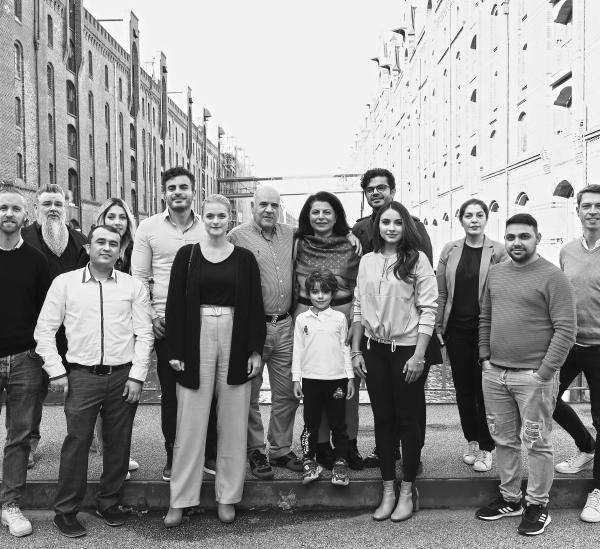
Since 1998, we deliver handmade oriental rugs and carpets of highest quality to you – in over 50 countries worldwide. Sitting in the historic Speicherstadt of Hamburg we benefit from a pool of strong expertise around oriental rugs. That’s exactly what we love to pass on to you when making you happy with our hand-crafted products.
Get to know us